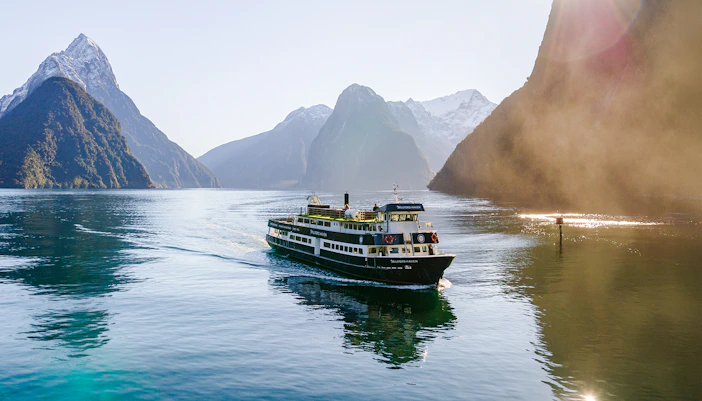
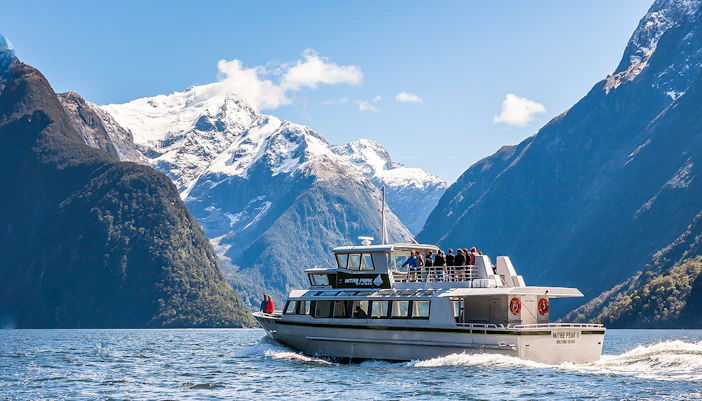
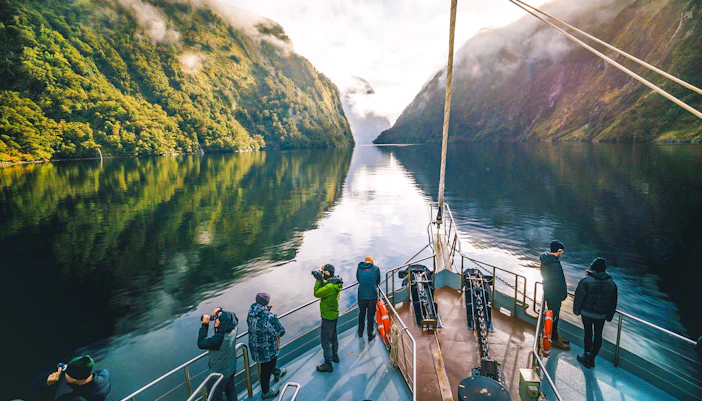
Cruise-only sailings run several times daily, and most standard routes spend about 1 hour 45 minutes to 2 hours 15 minutes on the water. Queenstown day trips start early and return late, while Te Anau departures shorten the road time. Overnight cruises check in in the afternoon and return the following morning.
Milford Sound, known in Māori as Piopiotahi, is a glacial fiord on the southwest coast of New Zealand's South Island. It runs 15 kilometres inland from the Tasman Sea, reaches 291 metres deep, and is walled by cliffs that rise more than 1,200 metres straight out of the water. It sits inside Fiordland National Park and is the only fiord in New Zealand you can reach by road.
Roughly a million people visit each year, most of them to take a cruise into the fiord, though you can also arrive by scenic flight, paddle it by kayak, or walk in over four days on the Milford Track.
Milford Sound at a glance
- Official name: Milford Sound / Piopiotahi
- Location: Fiordland National Park, South Island, New Zealand
- Formation: Glacial fiord, carved over millions of years
- Length: 15.1 km from Dale Point at the Tasman Sea
- Maximum depth: 291 m
- Maximum width: 1.94 km
- Signature peak: Mitre Peak, 1,692 m
- Permanent waterfalls: Lady Bowen Falls (162 m), Stirling Falls (~151 m)
- Annual rainfall: ~6,400 mm, among the wettest inhabited places on Earth
- Wildlife: NZ fur seals, bottlenose dolphins, Fiordland crested penguins
- Protected status: Te Wāhipounamu UNESCO World Heritage Area (1990); Piopiotahi Marine Reserve (1993)
- Visitors per year: Over 1 million
Why take a Milford Sound cruise?
1/4
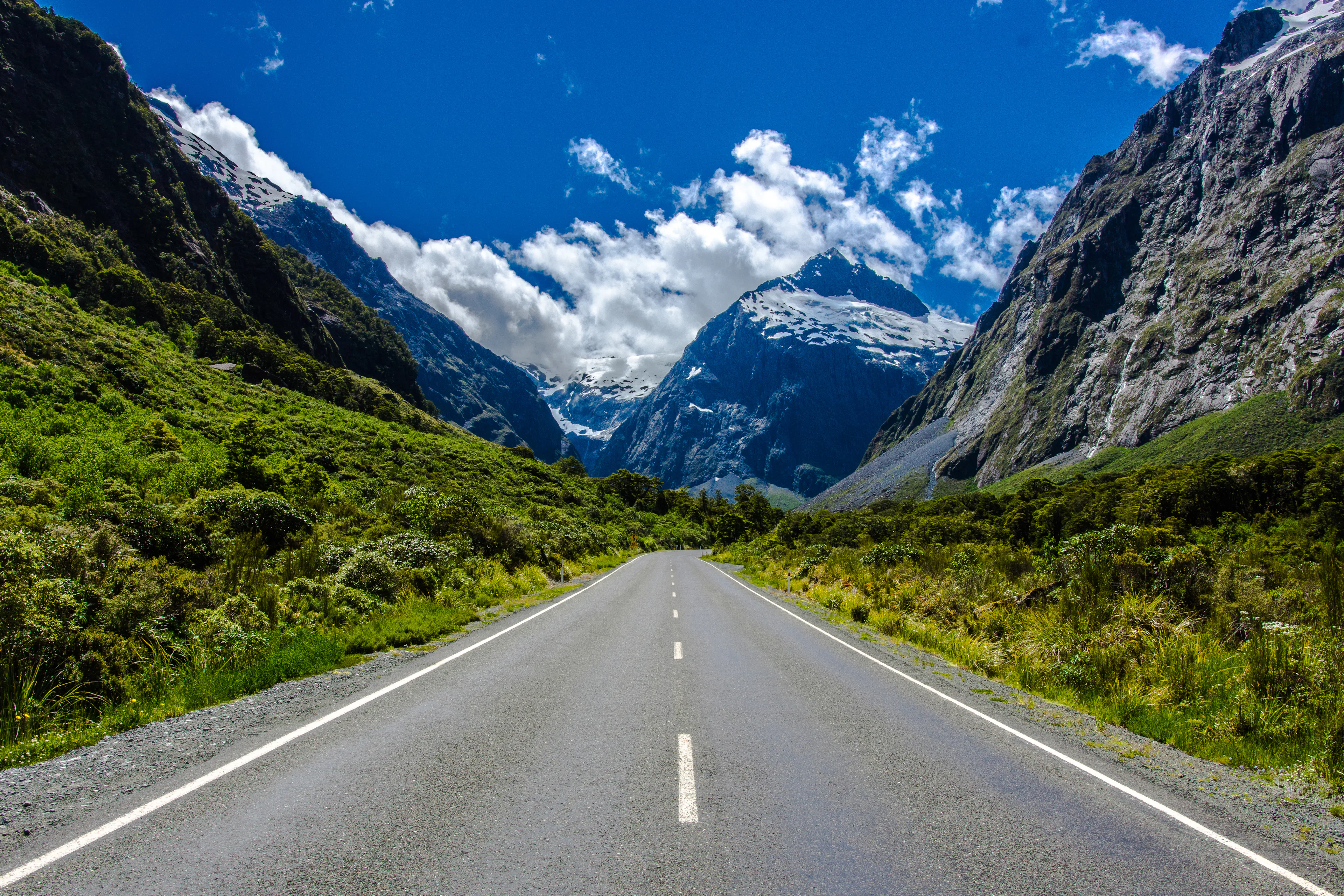
The road ends at the water
You can drive or ride into Milford, but the fiord itself opens up only once you leave the terminal by boat. The cruise gets you beneath the cliffs, not just beside them.
Waterfalls are seen from their base
Stirling Falls drops 155m and Bowen Falls drops 162m. From the deck, you see their full height and, on some vessels, feel the spray during close approaches.
Wildlife sightings are part of the route
Fur seals are common on the rocks near the outer sound, and dolphins sometimes ride the bow wave. Smaller boats can make wildlife viewing feel less crowded and more flexible.
From Queenstown, it is a long day
The cruise itself is compact, but many visitors pair it with a 12–13-hour round trip from Queenstown. If you want long hikes or multiple stops, choose a different Milford day format.
Plan your visit to Milford Sound cruises
Timetable
When to travel
November to April gives you longer daylight and the widest choice of departures, but January and February are the busiest months. For quieter decks, book the first available sailing or travel in April, May, September, or October. Small-boat, premium lounge, and overnight options are the ones that sell out first.
Where to board
Cruise-only departures board at the Milford Sound/Piopiotahi terminal at the head of the fiord, reached via State Highway 94 through the Homer Tunnel. From Te Anau, the drive is about 2 hours without stops; from Queenstown, expect a much longer day. If you do not want to self-drive, several options include coach or flight transfers.
What you see along the route
Leaving the wharf and entering the fiord
Once you pull away from the terminal, the built environment disappears quickly and the scale shifts. The mountains close in, the water flattens, and the first minutes are about adjusting to how steep the valley walls really are from water level. If you want uninterrupted photos, move outside early before people settle into their preferred deck spots.
Mitre Peak dominates the inner sound
Soon after departure, Mitre Peak becomes the visual anchor of the cruise. At 1,692m, it rises almost straight from the water, which is why it photographs so differently from the boat than from shore. On calm days, reflections can be almost symmetrical, so keep your camera ready even when the boat appears to be between major landmarks.
Waterfall passes are the dramatic midpoint
The most memorable section for many visitors is the run past Bowen Falls and the approach to Stirling Falls. Larger vessels give you more sheltered viewing, while boutique boats can make the waterfall pass feel closer and louder. If you care about that spray moment, small-boat departures are the ones to book first.
The outer sound feels wider and quieter
As the boat moves toward the Tasman Sea end of the fiord, the cliffs pull back and wildlife spotting becomes the focus. Fur seals are often visible on rock ledges, and dolphins appear unpredictably. Stay outside for this section if the weather allows—indoor lounges are comfortable, but you will hear the skipper’s wildlife callouts a beat later.
Why Milford Sound is a fiord, not a sound
The name is a misnomer that stuck. A sound is a river valley drowned by the sea. A fiord is a valley gouged out by a glacier and then flooded. Milford Sound is the second kind, which is why the surrounding national park is called Fiordland.
The difference is visible from the water. Glaciers cut U-shaped valleys with near-vertical walls and no shallow margin, so the cliffs here drop straight into deep water rather than easing in through a beach or a shelf. Hanging valleys are left stranded high on the rock faces where smaller side glaciers met the main ice flow, and those are what feed the waterfalls after rain.
Milford Sound has two layers of water that barely mix. Rainfall runs off the rainforest carrying tannins from the leaf litter, and that fresh water, being lighter, floats on top of the seawater in a layer up to 10 metres deep. It is stained dark brown, so it filters out most of the light reaching the salt water below.
The effect is that deep-sea conditions occur at shallow depths. Black coral, which normally grows hundreds of metres down, grows here within reach of divers. It also explains why the water looks almost black from the deck even on a bright day.
History
- Ngāi Tahu tradition: In the Ngāi Tahu account, the fiords were carved by Tū-te-Raki-whānoa, who worked south to north with his adze Te Hamo. Milford Sound was among his last and finest work, which is why its walls are the steepest. The name Piopiotahi comes from a separate story: a single piopio, a native thrush now extinct, flew to the fiord in mourning after the death of Māui. Tahi means one.
- European naming: The sealer John Grono entered the fiord in 1823 and named it Milford Haven after the harbour in his native Wales. The Cleddau River, which flows into the head of the fiord, takes its name from the same place.
- Settlement and tourism: Donald Sutherland built the first accommodation at Milford in 1878. The Milford Track opened as a walking route in 1888, and the Homer Tunnel finally connected Milford to the road network in 1954.
More on the wider region in our Fiordland National Park guide.
Need to know
- Cruise-only tickets assume you can reach the Milford terminal yourself; Queenstown and Te Anau day tours bundle the transport.
- Accessibility varies sharply by vessel: some cruises can take foldable wheelchairs or strollers, while several small-boat and premium options cannot.
- Flights and helicopters are the first Milford products affected by weather; standard cruises usually still operate unless conditions are severe.
- Not all upgrades are alike: reserved lounges, picnic lunches, farm stops, and guided walks are tied to specific products, not standard across all cruises.
Worth knowing
- Small-boat cruises are better if you want fewer people around you at the waterfall passes; multi-deck vessels are better if you want indoor shelter.
- Starting from Te Anau cuts several hours off the day compared with Queenstown departures.
- If quiet matters more than extras, first departures and overnight cruises change the feel of Milford more than onboard food does.
Frequently asked questions about Milford Sound
Yes. Milford Sound is commonly called a sound, but geologically it is a fiord carved by glaciers. That is why the walls are so steep and the water so deep close to shore.
Smaller formats are the best fit if crowd levels matter. The Milford Sound Boutique Small-Boat Cruise caps numbers at 75 guests, while VIP-style options focus on reserved lounge space rather than open-deck volume.
Only some products include food. Milford Sound Cruise with Optional Lunch, Overnight Milford Sound Cruise with Dinner & Activities, and several Queenstown and Te Anau day tours add lunch or onboard dining, while many standard cruises do not.
No. Self-drive works for cruise-only tickets, but many Headout experiences include transport, including From Queenstown: Milford Sound Day Trip with Cruise, & Return Transfers and From Te Anau: Milford Sound Day Trip with Cruise & Return Transfers.
It can be, if you value space and service rather than simply being on the water. Premium products usually add reserved seating, smaller groups, dedicated hosts, or better food, not a different fiord route.
Milford is easier to access and has more departure formats, while Doubtful Sound feels more remote and involves extra transfer stages. From Manapouri: Doubtful Sound Wilderness Cruise is the main Headout alternative if you want a longer wilderness-focused day.
Photographers usually prefer open decks or lower passenger counts. Boutique boats get you closer to waterfall spray, while flights and helicopter combinations add top-down views that cruise-only products cannot provide.
More Reads
Not applicable