‌‌‌‌
‌

Milford Sound's Waterfalls: Popular & Hidden Gems in New Zealand's Wettest Place

Milford Sound waterfalls come in two kinds. Lady Bowen Falls (162 m) and Stirling Falls (151 m) flow all year. Hundreds more appear only when it rains, sometimes within minutes of a downpour. The easiest way to see them is on a Milford Sound cruise, which passes both permanent falls and, conditions allowing, noses right into the spray of Stirling Falls. The tallest waterfall in the area, Sutherland Falls (580 m), is hidden in an inland valley. You can only reach it on the Milford Track or see it from a scenic flight.

Milford Sound waterfalls at a glance

  • Permanent waterfalls: Lady Bowen Falls (162 m) and Stirling Falls (151 m)
  • Rain-dependent waterfalls: Fairy Falls, the Four Sisters and hundreds of temporary falls
  • Tallest in the area: Sutherland Falls, 580 m, in three leaps, on the Milford Track
  • Best way to see them: A cruise, which passes both permanent falls on every departure
  • Closest approach: Stirling Falls, where boats and kayaks can reach the spray
  • Best conditions: During or just after heavy rain
  • Annual rainfall: Around 7 metres

Why does Milford Sound have so many waterfalls?

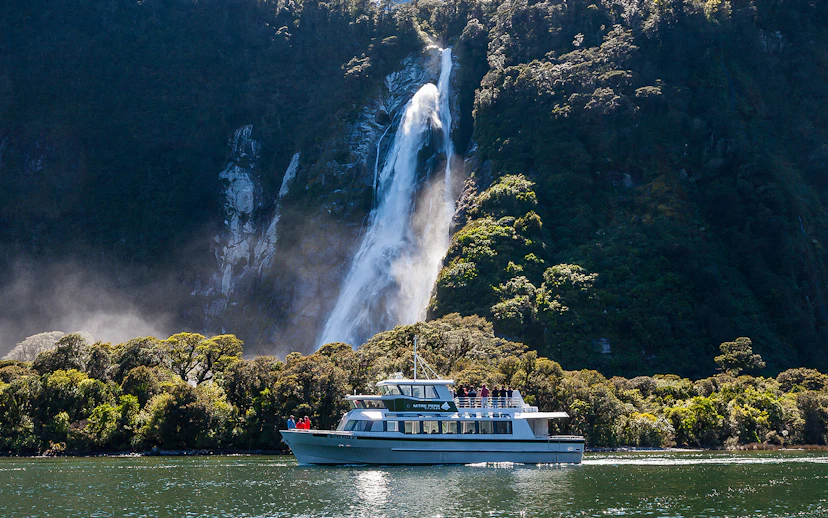
Cruise boat approaching waterfall in Milford Sound, New Zealand.

There are two reasons: the shape of the land and the amount of rain.

  • The land: During the last ice ages, glaciers carved Milford Sound into a deep, steep-sided U-shaped trough. The smaller glaciers in the side valleys couldn't cut as deep, so when the ice melted, those valleys were left "hanging" hundreds of metres above the fiord. Streams in those hanging valleys now spill straight off the cliff edge, which is why so many Milford Sound waterfalls plunge rather than tumble.
  • The rain: Milford Sound is one of the wettest inhabited places on earth, with around 7 metres of rain a year and up to 250 mm in 24 hours. The cliffs are hard granite and gneiss with a thin skin of moss and forest, so rain can't soak in and runs straight off the rock. Within minutes of heavy rain starting, white threads of water appear on the cliffs. After a few hours, the walls of the fjord can be streaked with hundreds of falls.
Explore Milford Sound

Milford Sound's permanent waterfalls

Lady Bowen Falls (162 m)

Lady Bowen Falls is the tallest waterfall in Milford Sound itself. It pours from a hanging valley on the northern shore, right beside the cruise terminal, so it's the first waterfall most visitors see. The falls are named after Diamantina Bowen, wife of Governor George Bowen, who visited Milford Sound in 1871. Their Māori name is Hine Te Awa.

Bowen Falls also does real work: it supplies the Milford Sound settlement with drinking water and hydroelectric power. In heavy rain its volume can multiply, and the spray drifts across the water toward the wharf.

How to see it: Every cruise passes Bowen Falls at the start or end of the trip, and you can see it from the Milford Sound foreshore. The Bowen Falls Walk to the base of the falls is permanently closed. DOC shut it because the boat service that carried walkers past an unstable section of track no longer runs. Older guides and blogs that recommend the walk are out of date.

Stirling Falls (151 m)

Stirling Falls is Milford Sound's second permanent waterfall, about halfway along the fiord. Its Māori name is Waimanu. It drops from a hanging valley between the Lion and the Elephant, and it's about three times the height of Niagara Falls. The 1,300 m mountains around it make it look far smaller than it is.

Because the falls land in deep water at the foot of a sheer cliff, cruise boats can edge in until the bow is in the spray. Crews call it a "glacial facial". Kayakers can paddle into the downdraft too. It's usually the moment everyone rushes to the outside deck, so bring a waterproof layer or stay inside if you want to stay dry.

How to see it: Every day cruise passes Stirling Falls. Smaller boats can often get closer, and the approach depends on wind and flow on the day.

More Milford Sound waterfalls

Rain-fed waterfalls

Fairy Falls

Fairy Falls is a slender waterfall on the fiord walls that runs most of the year, thanks to Milford Sound's frequent rain. It's a favourite photo stop from the water and one of the most-photographed falls after the two permanent ones. After long dry spells it can thin to a trickle.

The Four Sisters

The Four Sisters are four near-identical cascades that appear side by side on a single cliff face, but only when it rains. On a bright day after rain, they often catch a rainbow.

Temporary waterfalls

These are the hundreds of falls that appear on wet days and vanish within hours of the rain stopping. They range from hair-thin threads to powerful torrents pouring off the clifftops. In strong wind, some are blown sideways or even back upwards before they reach the water. No two days look the same, and many visitors say a wet-weather cruise was the most memorable part of their trip.

Waterfalls near Milford Sound

Sutherland Falls (580 m)

Sutherland Falls is one of the tallest waterfalls in New Zealand, dropping 580 m in three leaps from Lake Quill. It sits at the head of the Arthur Valley, around 20 km up the Milford Track from Milford Sound, so you can't see it from the fiord or from a cruise. It's named after Donald Sutherland, a settler who lived in Milford Sound and reached the falls with John Mackay in 1880. See it on a walk on the Milford Track or on a scenic flight.

Mackay Falls and Bell Rock

These lie on the final day of the Milford Track, beside the Arthur River. Mackay Falls tumbles into a pool below the track. Nearby Bell Rock is a boulder hollowed out by water, big enough to stand inside. Both are on the full Great Walk route, not on the day walk.

Giant Gate Falls

Giant Gate Falls is a broad cascade on the Arthur River, near the end of the Milford Track, viewed from a swing bridge. The pool at its base is a popular, very cold, summer swimming spot. You can reach it on a day walk: a water taxi takes you from Deepwater Basin to Sandfly Point, then it's about 11 km return along the track beside Lake Ada. The walk runs in the summer season.

Waterfalls on the Milford Road

The 120 km drive from Te Anau is a waterfall show of its own on wet days, especially beyond the Homer Tunnel. On the descent into the Cleddau Valley, dozens of falls spill down the valley walls.

The Chasm

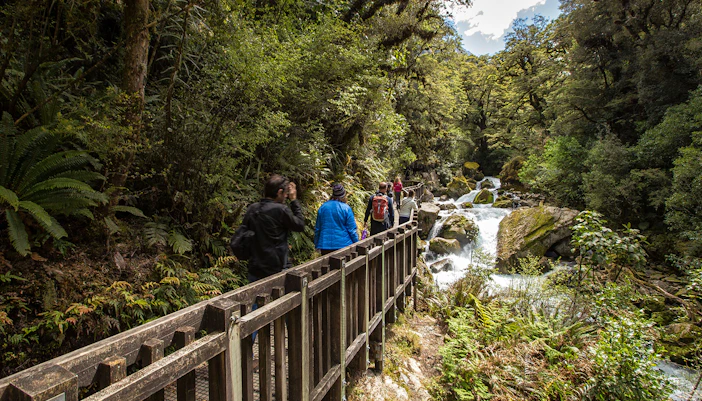
A short forest walk leads to where the Cleddau River has scoured smooth basins and holes through solid rock. It reopened in 2023 after the 2020 floods, initially with viewing from the riverbank only. Check DOC for current access before you go.

Humboldt Falls

These drop in three tiers in the Hollyford Valley. Reach them by a detour off the Milford Road and a short walk to a viewing platform.

How to see Milford Sound waterfalls

Couple enjoying Milford Sound waterfall view on cruise deck.
  • From Queenstown: Full-day coach + cruise tours with photo stops and close views of Bowen & Stirling Falls. Upgrade to flight combos for aerial views of Sutherland.
  • From Te Anau: Shorter day trips with transfers, a cruise, and stops like Mirror Lakes and The Chasm. Closest and most relaxed option.
  • On the Milford Track: Multi-day hikes lead to Sutherland Falls; day walks feature Giant Gate Falls.
  • By scenic flight: See Sutherland, Stirling, and countless rain-fed cascades from above, often combined with a cruise.
  • By cruise: The classic way, sail beneath Bowen, Stirling, and Fairy Falls. Morning and late cruises mean fewer crowds.

When is the best time to see Milford Sound waterfalls?

On a rainy day or just after one. It sounds backwards, but rain is when the waterfalls are at their best. Heavy rain overnight, followed by a clearing morning, gives you full falls and a better chance of seeing the peaks.

By season:

  • Spring (September–November): Snowmelt adds volume to the permanent falls, and snow still caps the peaks.
  • Summer (December–February): Frequent rain keeps the falls flowing, and days are long. Cruises are busiest around midday.
  • Autumn (March–May): Often calmer and clearer, with fewer temporary falls between rain spells.
  • Winter (June–August): Snow on the peaks, sharp light and fewer visitors. Long cold, dry spells can slow the temporary falls.

Time of day: Morning and late-afternoon cruises are quieter than the midday departures that coaches from Queenstown fill. After morning rain, the falls are often at peak flow around the middle of the day, so there's a trade-off between crowds and flow.

After a dry spell: The temporary falls disappear, Fairy Falls thins, and even Stirling Falls loses some of its power. Bowen and Stirling still flow, but the fiord looks very different.

History & significance of Milford Sound waterfalls

Milford Sound's Māori name is Piopiotahi, "a single piopio". In one telling of the legend, a lone piopio, a now-extinct native thrush, flew here to mourn the death of the demigod Māui. Māori travelled here for centuries to gather pounamu, and several waterfalls carry Māori names alongside their English ones: Hine Te Awa for Bowen Falls and Waimanu for Stirling Falls.

European names arrived in the 19th century. The sealer John Grono named the fiord Milford Haven after his home port in Wales, in the early 1820s. Bowen Falls was named in 1871 during a visit by Governor George Bowen. Sutherland Falls was named after Donald Sutherland, one of Milford Sound's first European settlers.

​Plan your Milford Sound experience
Tips for seeing the waterfalls

Milford Cruise
  • Don't cancel for rain. Cruises run in almost all weather, and rain makes the waterfalls.
  • Bring a waterproof jacket, even on a dry day, for the spray at Stirling Falls.
  • Protect your camera or phone with a waterproof cover or zip-lock bag if you plan to stand on deck at Stirling Falls.
  • Sit on the outside deck on the approach to Stirling Falls, then move inside if you don't want to get wet.
  • Use a fast shutter speed to freeze spray, or brace against a rail for softer, blurred water.
  • Look up: the tallest temporary falls start from the clifftops, 1,000 m above the water.

Myths and facts about Milford Sound waterfalls

  • "Rain will ruin my visit." False. Rain creates hundreds of extra waterfalls, and cruise boats have indoor lounges.
  • "You can see Sutherland Falls on a cruise." False. It's inland in the Arthur Valley, so you need the Milford Track or a flight.
  • "You can walk to Bowen Falls." Not anymore. The Bowen Falls Walk is permanently closed.
  • "Milford Sound has dozens of permanent waterfalls." False. It has two permanent falls, Bowen and Stirling. Most others depend on rain.

​More things to do in Milford Sound

Frequently asked questions about Milford Sound Waterfalls

Some of the most renowned Milford Sound waterfalls include Lady Bowen Falls, Stirling Falls, and Sutherland Falls, each renowned for their majestic beauty. Several semi-permanent waterfalls like the Fairy Falls and Bridal Veil Falls are also notably beautiful and famous.